Freshman year
Desmos art project
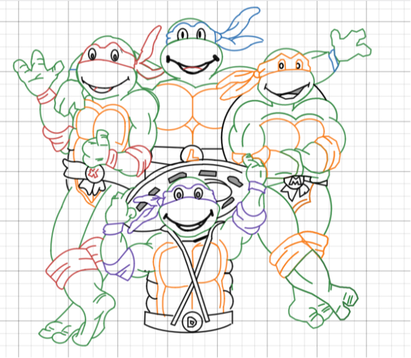
For this project, I worked in a group of 4 people to create art on Desmos. We decided to create the Teenage Mutant Ninja Turtles. This was a really hard project, we made art from equations like ( x - h )^2 + ( y - k )^2 = r (the equation of a circle) after grafting so many equations it eventually came together, overall the 4 turtles were over 900 equations.
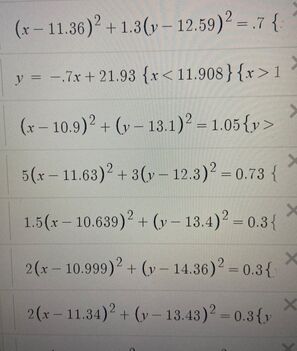
I worked on Leonardo as well as the editing when all the grafts were put together. We worked separately working on different parts of the refrinance picture, once we were all done we put the grafts together. Most people worked individually so putting the grafts together was its own issue. We used tables in some parts that would graph lines creating parabolas. All four of us in the group used the tables because it made it easier to graph a bunch of lines at once. Because we did them individually when we brought them together they canceled each other out. Individually I worked to retype over 100 hundred different tables so they would show in the final product it was slow and tedious but ultimately pretty easy.
I worked on Leonardo as well as the editing when all the grafts were put together. We worked separately working on different parts of the refrinance picture, once we were all done we put the grafts together. Most people worked individually so putting the grafts together was its own issue. We used tables in some parts that would graph lines creating parabolas. All four of us in the group used the tables because it made it easier to graph a bunch of lines at once. Because we did them individually when we brought them together they canceled each other out. Individually I worked to retype over 100 hundred different tables so they would show in the final product it was slow and tedious but ultimately pretty easy.
here's the finished product!
|
|
it doesn't look like much but each line you see was an individual equation.
This was equations from Leonardo's headband alone. As you can see its a lot!
This was equations from Leonardo's headband alone. As you can see its a lot!
Hero in my eyes project
|
|
Essential Question: How have the members of my community shaped my identity?
My father shows me every day what a hero is; he is the reason I have the confidence and personality I do. he has fully demonstrated to me what being a good person is, same as my mother; when my dad was away in the military she was the sole provider, my mother also shows me what good people look like, and I'm so grateful to have the family and parents I do for without them I wouldn't be me. |
|
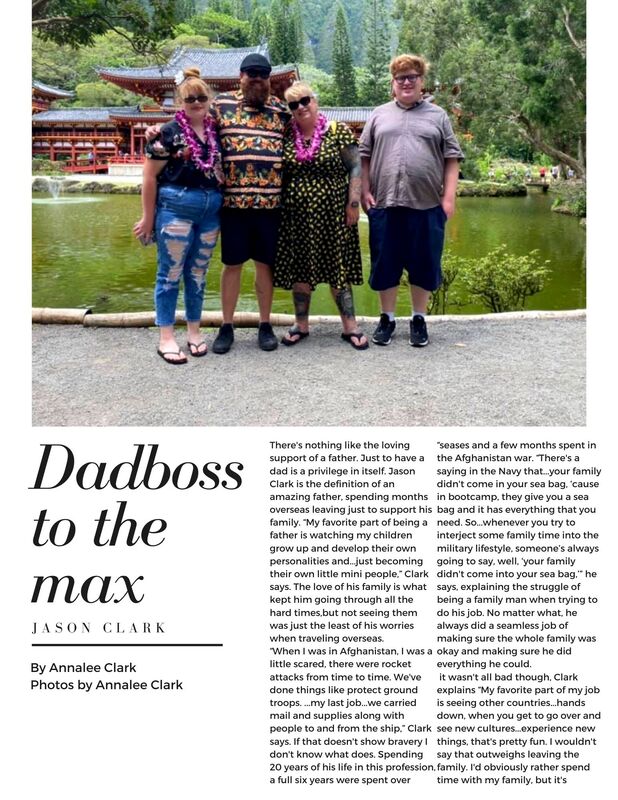
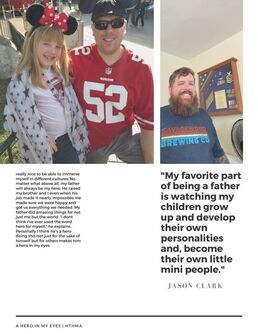
This was an assignment in humanities. For this project, I interviewed my dad about being a father in the military. The Interview took about ten minutes. I had ten questions, which he answered. I then had to transcribe what he said. I used his quotes and talked about his experience as a father and as an active duty chef. I loved this project because I learned much about him and how he felt when deployed. It was really sad to know all he had to give up, but I'm happy that I have him, and I'm grateful to have the dad I do. He is a family man and has done all that he can, so in every way, he is a hero, not just to me but to everyone.
Afrofuturism poster
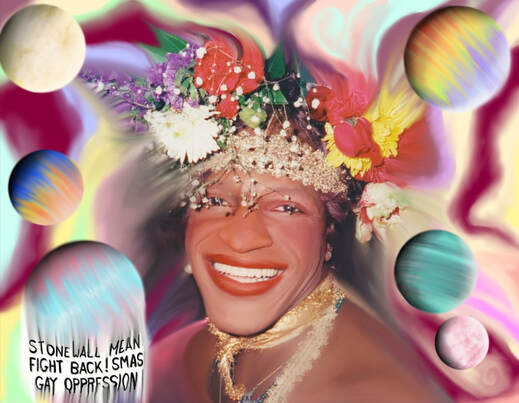
This was a project for multi-media, we were assigned to create an Afrofuturism poster on a powerful black person in history. I chose to do it on Marsha P Johnson, this project was powerful and we learned a lot about history, and what these people did. I think this poster is really creative and I'm really proud of how it came out. The different planets around her represent different things. I think this poster shows a good representation of how I see Marsha and how she did so much for so many communities.
Sophomore Year
Color, erased culture
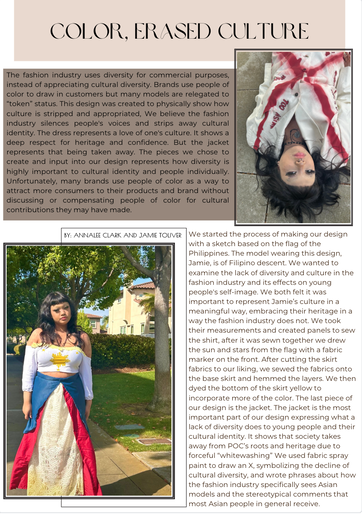
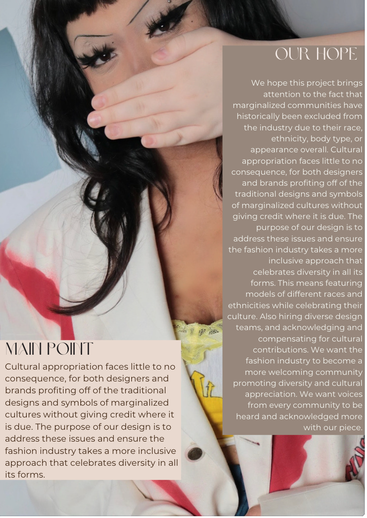
The first project I would like to highlight for my Sophomore year is this design project. I worked with a partner pictured below to create an article of clothing that represents an important topic. The topic I chose was the lack of diversity in the fashion industry. I designed and sewed a top and skirt based on the flag of the Philippines because my partner was of Filipino descent. We then created and spray pained a jacket with a red X along with sayings like "not my brand" or "too dark" to show how the fashion industry views models of color.
|
|
DIVERSITY IN THE FASHION INDUSTRY RESEARCH PAPER
I chose this topic because I felt it was really important to understand the voices of marginalized communities, I wanted to understand the lesser-known parts of the fashion industry. Throughout writing this paper I learned a lot about systemic racism and cultural appropriation. I believe it's important to not be ignorant, so the masses can better understand how to improve upon race theory and inclusivity.
Diversity in the fashion industry research paper
When you think of the fashion industry what comes to mind? Glamor? Runway shows? Celebrities? Unobtainable standards? Racism? Sexism? This paper will focus on the lack of diversity in the industry and its effects on the general public. The fashion industry has a large lack of diversity, both in terms of the models used to showcase clothing and the designers who create it. While progress has been made in recent years, there is still a long way to go before the industry can be called diverse. The standard in the industry has been a tall, thin, white woman. This narrow definition of beauty has excluded people of color and plus-size models, from the runway and advertising campaigns. Even when there are efforts to include more diverse models, they are often relegated to "token" status, appearing in a handful of shows or campaigns but not becoming a regular fixture in the industry or even leading to cultural appropriation and further discrimination towards marginalized communities. The fashion industry is not inclusive of bodies outside of the beauty standard which results in insecurity, marginalization, and cultural appropriation.
|
Companies preach diversity and inclusivity to draw in new consumers but in the end, the models they use in fashion weeks and advertisements are thin and white. This further perpetuates the idea that brands and designers can use plus-sized or models of color simply as a “token” and not a part of everyday operations. Some believe that there are economic reasons behind the industry’s discriminatory casting practices. While “it used to be about fashion,” it has turned into being “about business.” This argument is based on the idea that models of color are not hired more because they are less likely to sell The more prevalent argument, however, appears to be that in fashion, race is viewed as any other aesthetic feature, such as hair and eye color. (Whitewashed Runways: Employment Discrimination in the Fashion Modeling Industry, Vanessa Padul, 7) People of color are not an “aesthetic” companies can use when it's convenient to an audience. The same can be said about plus-sized models, casting companies use plus-sized or models of color when it helps sell a product, or falsely push the narrative of diversity without further action. When it comes down to it both are treated unfairly.
|
